Borosilicate vs. Soda-Lime Glass: Which Material Fits the Use?
Borosilicate and soda-lime glass are both useful, but they solve different problems. Borosilicate is often selected when low thermal expansion and resistance to rapid temperature change are important. Soda-lime glass is widely used for high-volume containers and architectural products where established forming processes and project economics carry more weight. The right choice depends on the glass grade, product geometry, intended contents, temperature cycle, decoration, closure, compliance requirements, and target cost—not on a blanket claim that one material is always “better.”
| Decision factor | Borosilicate glass | Soda-lime glass | What a buyer should verify |
|---|---|---|---|
| Composition concept | Silica-based glass formulated with boron oxide and other modifiers; exact recipes vary by grade. | Silica-based glass commonly formulated with sodium and calcium oxides plus other modifiers; exact recipes vary. | Supplier grade, composition declaration, and any restricted-substance requirements. |
| Thermal expansion | Generally lower for common technical borosilicate grades. | Generally higher for common container and technical soda-lime grades. | Coefficient of thermal expansion measured over a stated range and by a stated method, such as ISO 7991. |
| Thermal-shock performance | Often better suited to controlled hot/cold cycling, provided the product is correctly designed and annealed. | Can perform well within its designed temperature range, but abrupt temperature differences usually require more caution. | Finished-product test method, temperature differential, wall thickness, geometry, annealing, and surface condition. |
| Chemical durability | Many grades offer high hydrolytic and chemical resistance. | Performance ranges by formulation and can be fully suitable for many beverage, food, and technical uses. | Relevant water, acid, or alkali resistance class and testing under the actual contact conditions. |
| Forming and design | Often used in tubing, lampworking, technical components, and specialty hollowware; process choice affects feasible shapes and tolerances. | Well established in high-throughput container and float-glass manufacturing, with a broad industrial supply base. | Process route, tooling, tolerances, neck finish, wall distribution, decoration, and sample approval. |
| Typical uses | Laboratory ware, technical components, selected cookware, drinkware, jars, and shaped glass products. | Beverage bottles, food jars, tableware, windows, and many mass-market containers. | Whether the proposed grade and finished design match the exact use—not just the material family name. |
| Commercial trade-off | May require higher processing temperatures or more specialized production, depending on the grade and design. | May offer favorable economics for mature, high-volume processes, depending on the format and supply chain. | Comparable quotations based on the same drawing, order assumptions, QC plan, packaging, and delivery terms. |
Understanding the basics of glass composition
Both material families are based primarily on silica. Their behavior changes as manufacturers add different network formers and modifiers. Soda-lime formulations commonly use sodium and calcium oxides to support practical melting and forming. Borosilicate formulations include boron oxide, which helps produce the low thermal expansion associated with many technical borosilicate grades.
Those family names are only a starting point. Two products described as “borosilicate” may use different grades, processes, wall profiles, and annealing cycles. The same is true of soda-lime products. For sourcing decisions, ask for the actual glass designation and supporting data rather than relying on a category label alone. This overview of borosilicate glass bottles provides additional application context.
The key difference: thermal response
Thermal expansion describes how much a material changes dimension as temperature changes. Lower expansion generally reduces thermally induced stress, which is one reason borosilicate is frequently considered for products that face temperature cycling.
For scale, SCHOTT reports a mean coefficient of linear thermal expansion of 3.25 × 10⁻⁶ K−1 from 20–300 °C for its BOROFLOAT® 33 borosilicate grade, measured according to ISO 7991. Its AR-GLAS® soda-lime technical data reports 9.1 × 10⁻⁶ K−1 over the same range and method. These are useful examples from two named products—not universal values for every borosilicate or soda-lime formulation.
Coefficient data alone does not prove that a finished bottle, jar, or decanter can move safely from a freezer to an oven or accept boiling liquid. Thermal-shock performance also depends on shape, wall-thickness variation, annealing, residual stress, scratches, attachments, and the test setup. Specify the real temperature cycle and validate representative finished samples before making a use claim.
Chemical durability and food-contact suitability
Many borosilicate grades offer strong hydrolytic and chemical resistance, which supports their use in laboratory and technical applications. Soda-lime grades also cover a wide performance range and are used extensively for food and beverage containers. The meaningful comparison is a named grade tested against the liquids, pH, temperature, and contact time expected in service.
Material family does not, by itself, establish that a finished product is suitable for food or beverage contact. Colorants, coatings, decals, printing, closures, adhesives, and manufacturing controls may all affect the compliance assessment. The U.S. FDA explains that the regulatory status of a food-contact material depends on its components, specifications, limitations, and intended conditions of use. Buyers should request supplier declarations and relevant migration or extractable-element reports for the destination market and finished decoration—not accept “food safe” as an unsupported material-level promise.
Strength, breakage, and clarity
Hardness, impact strength, fracture behavior, and thermal-shock resistance are different properties. A hardness number does not tell a buyer whether a completed container will survive filling, packing, transport, or a drop. Glass remains brittle, and either material can fail when it is damaged, poorly annealed, unevenly formed, or used outside its design conditions.
For a meaningful durability review, compare finished products with the same capacity and intended use. Inspect wall distribution, residual stress, rim and neck quality, attachment points, surface defects, base stability, and protective packaging. Optical appearance should likewise be judged on approved samples because glass color, wall thickness, curvature, coatings, and inclusions affect the result.

Application in drinkware and decanters
Borosilicate can be a useful choice for lightweight-looking forms, internal details, and specialty hand-shaped drinkware. Soda-lime can be a practical choice for many conventional bottles, jars, and decanters. Neither selection guarantees flavor preservation, safety, or break resistance without a defined specification and controlled production.
For spirit packaging, buyers should prioritize closure compatibility, fill-line conditions, decoration durability, dimensional control, extractable-element requirements, and packaging performance. A product intended only for ambient storage has a different risk profile from one promoted for heating, rapid cooling, or repeated dishwasher cycles. Browse the glass decanter category for examples of different forms, then evaluate each concept against its use case.
Exploring shaped-glass designs
Complex silhouettes and internal features can be produced through several glass-forming routes, but feasibility is design-specific. A shape that works in lampworked borosilicate may not transfer directly to an automated soda-lime container line, and the reverse can also be true. Narrow sections, abrupt thickness changes, unsupported details, and difficult mold release can affect yield and consistency.
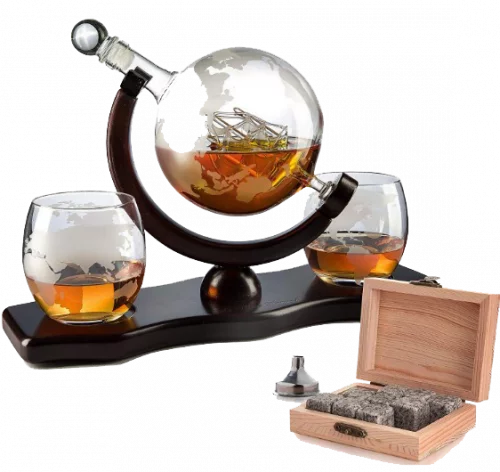
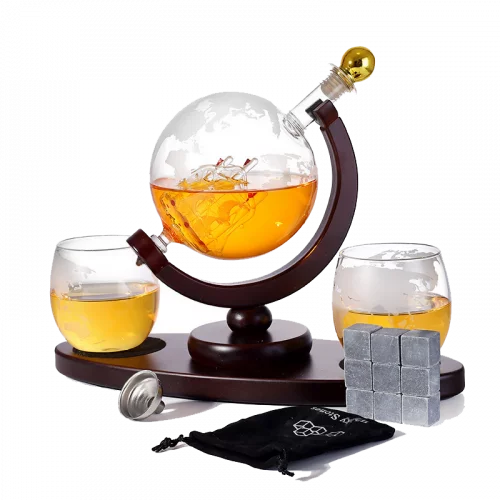
Examples such as globe decanters and rifle-shaped decanters show how strongly geometry can influence the product. A manufacturability review should happen before tooling, with the material and process chosen together rather than in isolation.
Beyond decanters
Borosilicate is also used for technical glass, selected cookware and drinkware, and specialty storage products. Soda-lime remains common across bottles, jars, tableware, and window glass. The broad range of uses is a reminder that the best material is application-dependent. For container projects, explore examples in the glass jars category and compare them with your performance and commercial requirements.
The manufacturing and cost perspective
Some borosilicate grades have higher working temperatures and rely on specialized forming skills or equipment. Mature soda-lime container processes can offer efficient production at scale. However, material name alone does not determine unit cost. Geometry, product weight, forming route, yield, tooling, decoration, tolerances, inspection, order profile, energy, packaging, and freight can change the result.
Request quotations against one controlled brief. If suppliers are pricing different wall thicknesses, neck finishes, QC levels, or cartons, the lowest unit price is not a like-for-like comparison. Early mold and prototype work should also define ownership, revision control, sample approval, and the tests required before production. This guide to glass bottle mold craftsmanship explains why tooling decisions matter.
Soda-lime glass: the established everyday choice
Soda-lime glass is widely used because its supply chain and forming technologies suit many common products. It can be the right choice when extreme temperature cycling or a particular chemical-resistance class is not required and when the design aligns with an established manufacturing process. “Everyday” does not mean inferior; it means the specification should match the intended job.
Likewise, choosing borosilicate only for a premium story can add complexity without solving a real requirement. Define the performance target first, then compare viable processes and samples.
Buyer specification checklist
Before requesting a quote or approving a material, document the following:
- Product use: contents, fill process, service life, cleaning method, and whether the item is packaging, drinkware, cookware, or a decorative product.
- Temperature profile: minimum and maximum temperatures, rate of change, repeated cycles, and the exact finished-product test.
- Chemical exposure: liquid composition, pH, alcohol content where relevant, contact time, and cleaning agents.
- Glass grade: supplier designation, composition or declaration, thermal-expansion data, and applicable chemical-resistance classes.
- Geometry: capacity, dimensions, target weight, wall distribution, base, neck finish, attachments, and tolerances.
- Compliance: destination market, intended food-contact conditions, restricted substances, decoration and coating requirements, and required reports.
- Quality plan: appearance limits, dimensional checks, annealing or residual-stress control, leak/closure tests, sampling level, and approved reference sample.
- Packaging: inner protection, dividers, carton strength, pallet pattern, and a documented transport or drop-test protocol.
- Commercial assumptions: tooling, sample revisions, order scenario, production yield assumptions, packing, delivery terms, and lead-time confirmation.
Frequently asked questions
What is the main difference between borosilicate and soda-lime glass?
Their formulations and resulting properties differ. Common borosilicate grades usually have lower thermal expansion, while soda-lime grades are widely used in established container and flat-glass processes. The relevant comparison is between named grades and finished-product requirements.
Is borosilicate glass always safer for food and beverages?
No material-family label proves food-contact suitability. Compliance depends on the actual formulation, decorations, coatings, closure system, manufacturing controls, destination-market rules, and intended conditions of use. Request product-specific declarations and test evidence.
Does borosilicate glass never crack with hot or cold liquids?
No. Lower thermal expansion can improve resistance to thermal stress, but borosilicate is still glass and can crack. Finished-product performance depends on geometry, wall distribution, annealing, damage, and the size and speed of the temperature change. Follow the validated use instructions for the specific product.
Is borosilicate always more expensive?
Not necessarily in every project. Its processing route may add cost, but the final comparison also depends on design, tooling, yield, quantity, decoration, QC, packaging, and freight. Compare quotations built from the same specification.
Which glass is better for a custom bottle or decanter?
Choose after defining the contents, temperature cycle, shape, finish, compliance needs, volume assumptions, and target cost. A manufacturability review and representative sample testing provide better evidence than choosing from the material name alone.
Technical references
- SCHOTT: Technical details of BOROFLOAT® 33 — named borosilicate-grade data, including thermal properties and chemical-resistance information.
- SCHOTT: Technical details of AR-GLAS® — named soda-lime technical-glass data; values should not be generalized to every soda-lime container.
- U.S. FDA: Determining the regulatory status of components of a food-contact material — explains why compliance depends on the components, specifications, limitations, and intended use.
